原爆なかった論の戯言:林千勝の大嘘(5)〜毒ガスを懸念したのは米国の方の続きですが、この記事は非常に長いです。
本記事の三行要約
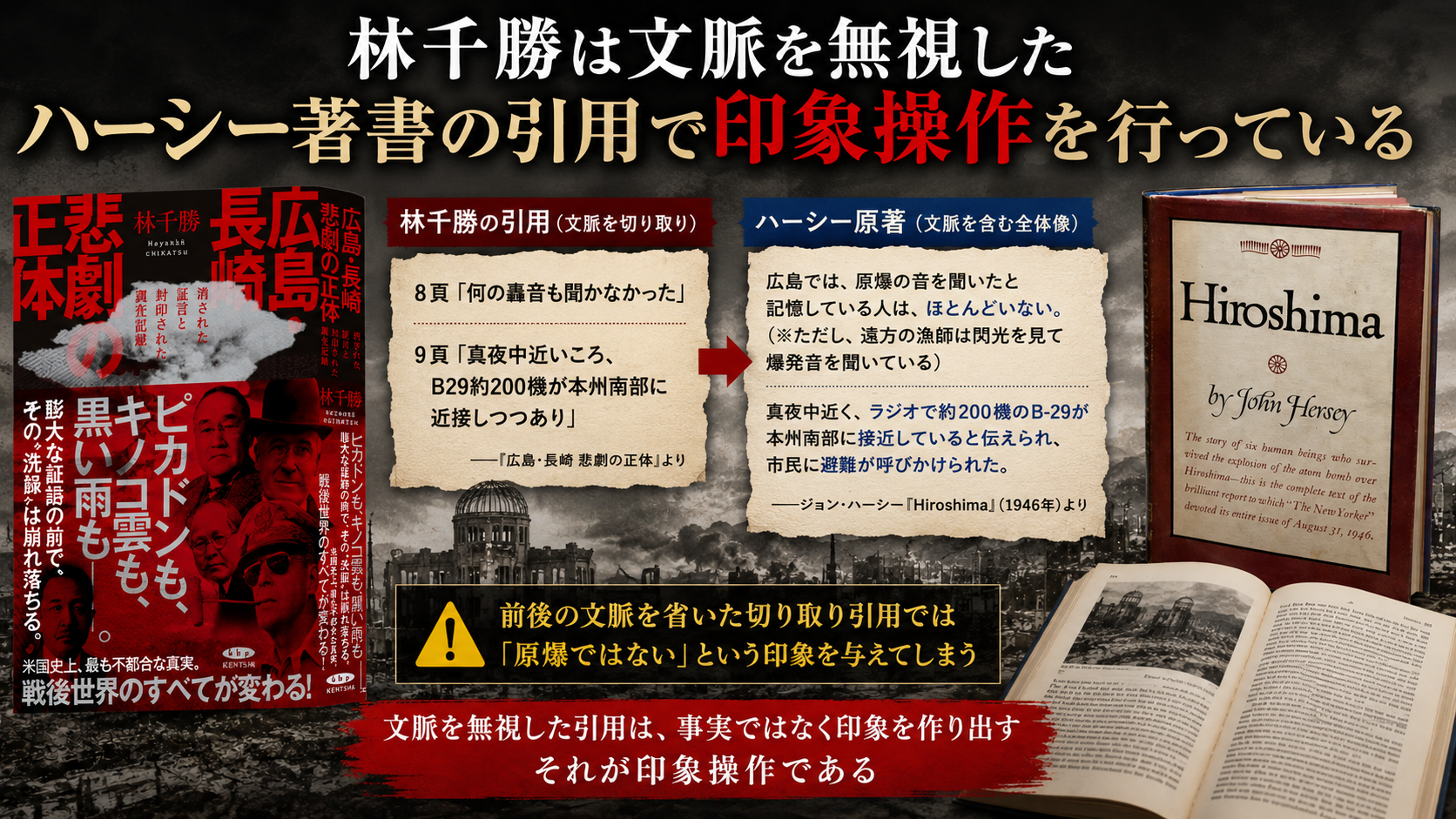
- 林は、ジョン・ハーシー『ヒロシマ(1946)』の一部の記述を「大規模複合爆弾を示すもの」とするが、原著の文脈を確認すると、その解釈は成立しない。
- 具体的に、「ガソリン」「毒ガス」「焼夷弾」「植物の急速な再生」などの記述を原文と照合すると、いずれも林が前後の文脈を省略している。
- ハーシーの記述は原爆投下の存在を前提とした被爆者の体験・証言であり、林の引用は文脈を外して「原爆ではない」という印象操作を行っており、極めて悪質。
林は、本書P154で、ジョン・ハーシーの『ヒロシマ』という本についてやはり極解し、
「著者の意図に反して、ピカドンではなく大規模複合爆弾であることを示してしまっている個所が多い」
と主張しています。ここでも嘘、あるいは印象操作が明らかです。これについて見ていきます。
そもそも、ハーシーの本は1946年に発行されたもので、むしろ広島への原爆投下が実際に起きたことを前提とし、被爆者6人の体験を記録したノンフィクションです。ハーシーに関するWikipediaは日本語、英語共にあります。英語版の一部を翻訳してみましょう。
広島からのレポート
原爆投下から2か月後、1945年10月の廃墟と化した広島
1945年8月6日、午前8時15分ちょうど、日本時間で、原子爆弾が広島上空で閃光を放ったその瞬間、東洋金属工場の人事部に勤める事務員、佐々木敏子さんは、工場事務所の自分の席に腰を下ろしたばかりで、隣の机にいる女性に話しかけようとして頭をそちらに向けていた。――ジョン・ハーシー『Hiroshima(広島)』(1946年)冒頭の一文
その後まもなく、ジョン・ハーシーは、『ニューヨーカー』誌の編集者ウィリアム・ショーンと、前年夏の爆撃についての長編記事を執筆することについて話し合いを始めた。ハーシーは、生き残った人々一人ひとりを通して、この破局的な出来事を描き出す記事を提案した。1946年5月、ハーシーは日本へ渡り、3週間をかけて調査を行い、被爆生存者たちにインタビューした。6月下旬にアメリカへ戻ると、広島で生き残った6人――ドイツ人のイエズス会司祭、未亡人の仕立屋、2人の医師、牧師、そして工場で働いていた若い女性――の体験を書き始めた。こうして完成したのが、彼の最も著名な作品となった31,000語のルポルタージュ「Hiroshima(広島)」である。これは1946年8月31日号の『ニューヨーカー』に掲載された。記事は、1945年8月6日にこの日本の都市へ投下された原子爆弾と、それが6人の生存者に及ぼした影響を扱ったものだった。この記事は雑誌のほぼ全ページを占めた。これは、『ニューヨーカー』誌にとって、それまで一度もなかったことであった。
さて、ハーシーの原著は、こちらで誰でも閲覧できます。林が参照しているのは、2014年発行の翻訳『ヒロシマ<増補版>』なのですが、原著の方で見ていきます。林によれば、以下の部分が「大規模複合爆弾であることを示している」のだそうです。
以下に示しますが、邦訳書の引用には前後の文脈がなく、つまり、完全な切り取りです。さらに、これらの部分がなぜ「大規模複合爆弾であることを示している」のか、何の説明もないのです。非常に悪質です。
1.何の轟音も聞かなかった
林は、邦訳書のページ数を付して次のように引用しています。
8頁「何の轟音も聞かなかった」
原文を見てみます。
原著印刷ページ番号8,9:Then a tremendous flash of light cut across the sky. Mr. Tanimoto has a distinct recollection that it travelled from east to west, from the city toward the hills. It seemed a sheet of sun. Both he and Mr. Matsuo reacted in terror—and both had time to react (for they were 3,500 yards, or two miles, from the center of the explosion).
そのとき、ものすごい閃光が空を横切った。谷本氏には、それが東から西へ、つまり市街地から山の方へ向かって進んだという明確な記憶があった。それは、太陽の光の幕のように見えた。谷本氏と松尾氏はともに恐怖に反応した――そして、二人とも反応するだけの時間があった(というのも、二人は爆発の中心から3,500ヤード(約3.2 km)、すなわち約2マイル離れたところにいたからである)。
Mr. Matsuo dashed up the front steps into the house and dived among the bedrolls and buried himself there. Mr. Tanimoto took four or five steps and threw himself between two big rocks in the garden. He bellied up very hard against one of them. As his face was against the stone, he did not see what happened. He felt a sudden pressure, and then splinters and pieces of board and fragments of tile fell on him. He heard no roar.
松尾氏は家の正面階段を駆け上がって家の中へ入り、寝具の中に飛び込んで、そこに身を伏せた。谷本氏は4、5歩進み、庭にあった二つの大きな岩の間に身を投げ出した。そして、そのうちの一つに体を強く押しつけた。顔を石に向けていたため、彼には何が起きたのか見えなかった。突然の圧力を感じ、続いて木材の破片や板のかけら、瓦の破片が彼の上に降り注いだ。彼には轟音が聞こえなかった。
(Almost no one in Hiroshima recalls hearing any noise of the bomb. But a fisherman in his sampan on the Inland Sea near Tsuzu, the man with whom Mr. Tanimoto’s mother-in-law and sister-in-law were living, saw the flash and heard a tremendous explosion: he was nearly twenty miles from Hiroshima, but the thunder was greater than when the B-29s hit Iwakuni, only five miles away.)
(広島では、原爆の音を聞いたと記憶している人は、ほとんどいない。しかし、津々近くの瀬戸内海で伝馬船に乗っていた漁師――谷本氏の義母と義姉が一緒に暮らしていた人物――は、その閃光を見て、ものすごい爆発音を聞いた。彼は広島から約20マイル(約32 km)離れたところにいたが、その轟音は、わずか5マイルしか離れていない岩国をB-29が攻撃したときよりも大きかった。)
なんでこれが「大規模複合爆弾を示す」のか、まるでわかりませんね。AIに聞いてみると、こういう説明でした。ほんとうかどうかわかりませんが。。。
音の聞こえ方は距離だけで単純に決まるわけではありません。遠距離では、爆発による音波が「爆発音」として伝わってくる一方、近距離では極端な爆風、建物の破壊音、耳への影響、遮蔽物などが重なります。さらに谷本氏は岩の陰に身を伏せ、顔を石に押しつけています。これは音の伝わり方にも影響します。
2.B29約200機が本州南部に近接
以下同様に、林の引用は邦訳書のページ数です。
9頁「真夜中近いころ、B29約200機が本州南部に近接しつつあり」
以下同様に、私の引用は原著の印刷ページ数です。
同10:At nearly midnight, the night before the bomb was dropped, an announcer on the city’s radio station said that about two hundred B-29s were approaching southern Honshu and advised the population of Hiroshima to evacuate to their designated “safe areas.” Mrs. Hatsuyo Nakamura, the tailor’s widow, who lived in the section called Nobori-cho and who had long had a habit of doing as she was told, got her three children—a ten-year-old boy, Toshio, an eight-year-old girl, Yaeko, and a five-year-old girl, Myeko—out of bed and dressed them and walked with them to the military area known as the East Parade Ground, on the northeast edge of the city. There she unrolled some mats and the children lay down on them. They slept until about two, when they were awakened by the roar of the planes going over Hiroshima.
原爆が投下される前夜、真夜中近くになって、広島市のラジオ局のアナウンサーは、約200機のB-29が本州南部に接近していると伝え、広島市民に対して、指定された「安全地域」へ避難するよう勧告した。仕立屋の未亡人である中村初代夫人は、幟町と呼ばれる地区に住んでおり、以前から言われたことには素直に従う習慣があった。彼女は3人の子供――10歳の息子俊夫、8歳の娘八重子、そして5歳の娘美枝子――をベッドから起こして服を着せ、彼らを連れて、市の北東端にある東練兵場と呼ばれる軍用地へ歩いて行った。そこで彼女は敷物を広げ、子供たちはその上に横になった。彼らは午前2時ごろまで眠り、そのころ広島上空を通過していく飛行機の轟音によって目を覚ました。
これについては以前も書きましたが、前日夜に宇部への爆撃があったのです。また、これらの爆撃機が翌日の「原爆投下」あるいはそれ以降に広島を爆撃することはありえません。単純に燃料がつきてしまうからです。だいたい、エノラ・ゲイがテニヤン島を離陸したのは日本時間で午前1時45分です。「偽装原爆」を落とそうとしている他の機体が、午前2時に広島上空をうろうろしているわけがありません。まったく辻褄があわないのです。
さらに、AIに聞いてみたところ、以下の状況だったとのこと。
この夜は、実際に612機のB-29が日本に対する1件の機雷敷設、1件の高性能爆弾攻撃、4件の焼夷爆撃を行っています。特に広島に比較的近い地域としては以下です。
- Mission 315:宇部 23:23~01:31
- Mission 316:今治 01:01~01:47
- Mission 314:西宮・御影 01:25~02:01
- Mission 311:日本海側の機雷敷設 23:23~02:32
もちろん、「原爆投下」以前に攻撃することもありえません。これは偽装説であっても同意するところでしょうね。
3.爆弾自体が幾個所かに火災を起こした爆心地
32頁「爆弾自体が幾個所かに火災を起こした爆心地」
同28:A nervous neighbor, Mrs. Hataya, called to Mrs. Nakamura to run away with her to the woods in Asano Park—an estate, by the Kyo River not far off, belonging to the wealthy Asano family, who once owned the Toyo Risen Kaisha steamship line. The park had been designated as an evacuation area for their neighborhood. Seeing fire breaking out in a nearby ruin (except at the very center, where the bomb itself ignited some fires, most of Hiroshima’s citywide conflagration was caused by inflammable wreckage falling on cookstoves and live wires), Mrs. Nakamura suggested going over to fight it. Mrs. Hataya said, “Don’t be foolish. What if planes come and drop more bombs?” So Mrs. Nakamura started out for Asano Park with her children and Mrs. Hataya, and she carried her rucksack of emergency clothing, a blanket, an umbrella, and a suitcase of things she had cached in her air-raid shelter.
神経質になっていた近所の女性、畑谷夫人は、中村夫人に声をかけ、一緒に浅野公園の森へ逃げようと誘った。浅野公園は近くを流れる京橋川のほとりにある邸園で、かつて東洋汽船会社を所有していた裕福な浅野家の所有地だった。その公園は、彼女たちの近隣住民のための避難区域に指定されていた。近くの廃墟から火が出ているのを見て、(ただし、爆心地そのものでは爆弾自体がいくつかの火災を引き起こしたが、広島市全体に広がった大火の大部分は、燃えやすい残骸がかまどや通電中の電線の上に落下したことによって引き起こされた)、中村夫人は、そこへ行って火を消そうと提案した。すると畑谷夫人は言った。「馬鹿なことをしないで。もし飛行機が来て、もっと爆弾を落としたらどうするの?」そこで中村夫人は、子供たちと畑谷夫人を連れて浅野公園へ向かい始めた。彼女は、非常用の衣類を入れたリュックサック、毛布、傘、それに防空壕にしまっておいた物を入れたスーツケースを持っていた。
意味がわかりませんね。「(爆心地では)爆弾自体が幾個所かに火災を起こした」から何だというんでしょうか?「これが複合爆弾の証拠だ!」とでも言うんでしょうかね?
4.火の手は二個所、まだ火の手は数える程
37頁「火の手は二個所」「まだ火の手は数える程しかない」
同32,33:At first, Dr. Fujii could see only two fires, one across the river from his hospital site and one quite far to the south. But at the same time, he and his friend observed something that puzzled them, and which, as doctors, they discussed: although there were as yet very few fires, wounded people were hurrying across the bridge in an endless parade of misery, and many of them exhibited terrible burns on their faces and arms. “Why do you suppose it is?” Dr. Fujii asked. Even a theory was comforting that day, and Dr. Machii stuck to his: “Perhaps because it was a Molotov flower basket,” he said.
初めのうち、藤井医師に見えた火の手は二つだけだった。一つは、彼の病院があった場所の対岸に、もう一つはかなり南の方に上がっていた。しかし同時に、彼と友人の町井医師は、不可解なことに気づき、医師としてそれについて話し合った。まだ火の手はほんの数えるほどしかなかったのに、負傷者たちが橋を渡って、果てしなく続く悲惨な行列となって押し寄せていたのである。 そして、その多くは顔や腕にひどい火傷を負っていた。 「なぜだと思いますか?」と藤井医師は尋ねた。その日には、たとえ一つの仮説であっても心の慰めになった。そして町井医師は自分の説を変えなかった。「おそらく、モロトフ・フラワー・バスケット(※クラスター爆弾のこと)だったからでしょう」と彼は言った。
There had been no breeze earlier in the morning when Dr. Fujii had walked to the railway station to see his friend off, but now brisk winds were blowing every which way; here on the bridge the wind was easterly. New fires were leaping up, and they spread quickly, and in a very short time terrible blasts of hot air and showers of cinders made it impossible to stand on the bridge any more. Dr. Machii ran to the far side of the river and along a still unkindled street. Dr. Fujii went down into the water under the bridge, where a score of people had already taken refuge, among them his servants, who had extricated themselves from the wreckage. From there, Dr. Fujii saw a nurse hanging in the timbers of his hospital by her legs, and then another painfully pinned across the breast. He enlisted the help of some of the others under the bridge and freed both of them. He thought he heard the voice of his niece for a moment, but he could not find her; he never saw her again.
その日の朝早く、藤井医師が友人を見送るために駅まで歩いて行ったときには、風はまったくなかった。ところが今では、風が四方八方から激しく吹いていた。ここ橋の上では、風は東から吹いていた。新しい火の手が次々と上がり、火は急速に広がっていった。そして、ほんの短い時間のうちに、猛烈な熱風と燃え殻の雨が襲ってきて、橋の上に立っていることはもはや不可能になった。町井医師は川の向こう岸へ走り、まだ火のついていない通りを駆け抜けた。藤井医師は橋の下の水中へ入った。そこにはすでに20人ほどの人々が避難しており、その中には、瓦礫から自力で脱出した彼の使用人たちもいた。そこから藤井医師は、自分の病院の木材の中に、両脚を引っ掛けられた状態でぶら下がっている看護婦を見た。さらにもう一人の看護婦が、胸のあたりをひどく挟まれて動けなくなっているのが見えた。彼は橋の下にいた他の人々に助けを求め、二人とも救出した。彼は一瞬、姪の声を聞いたように思った。しかし、彼女を見つけることはできなかった。彼は二度と彼女を見ることはなかった。
なぜこれが「大規模複合爆弾」を示すんでしょうか?意味不明です。
5.竹、松、月桂樹、楓の類が枯れもせず
57頁「(「爆心」直下から1.2キロメートルの)大庭園は……竹、松、月桂樹、楓の類が枯れもせずに元のまま青々として、避難者のしたいよる場所となった」
同47:All day, people poured into Asano Park. This private estate was far enough away from the explosion so that its bamboo, pines, laurels, and maples were still alive, and the green place invited refugees—partly because they believed that if the Americans came back, they would bomb only buildings; partly because the foliage seemed a center of coolness and life, and the estate’s exquisite perspective, covered by quiet pools and arching bridges, were very Japanese, normal, secure; and also partly (according to some who were there) because of an irresistible, atavistic urge to hide under leaves.
一日中、人々が浅野公園へ次々と押し寄せてきた。この私有地は爆発地点から十分に離れていたため、そこに生えていた竹、松、月桂樹、楓は、なお生きたまま残っていた。そして、この緑豊かな場所は避難民を引き寄せた。その理由の一つは、もしアメリカ軍が戻ってきたとしても、建物だけを爆撃するだろうと、彼らが考えていたからだった。また一つには、木々の茂みが涼しさと生命の中心のように感じられたからだった。そして、静かな池と弧を描く橋に彩られたこの庭園の美しい景観は、いかにも日本的で、平常で、安全なものに思われた。さらにもう一つには、そこにいた人々の何人かによれば、葉の下に隠れたいという、抗いがたい、太古からの本能的な衝動があったからだった。
「竹、松、月桂樹、楓は、なお生きたまま残っていた」がおかしいと林は言いたいんですかね?爆心地から十分離れていたと書かれていますが。
6.米機の落としたガスにあてられたのだと考えた
58頁「吐き気を催した人は他にもたくさんいたが、みんな、米機の落としたガスにあてられたのだと考えた」(強い臭い……のためらしい)
同47,48:Mrs. Nakamura and her children were among the first to arrive, and they settled in the bamboo grove near the river. They all felt terribly thirsty, and they drank from the river. At once they were nauseated and began vomiting, and they retched the whole day. Others were also nauseated; they all thought (probably because of the strong odor of ionization, an “electric smell” given off by the bomb’s fission) that they were sick from a gas the Americans had dropped. When Father Kleinsorge and the other priests came into the park, nodding to their friends as they passed, the Nakamuras were all sick and prostrate.
中村夫人と子供たちは、最初に到着した人々の中におり、川の近くの竹林に落ち着いた。彼らは皆、ひどく喉が渇いていたので、川の水を飲んだ。するとすぐに吐き気を催し、吐き始め、一日中えずき続けた。ほかの人々も吐き気を催した。彼らは皆、(おそらく、原爆の核分裂によって放出された「イオン化の強い臭い」、つまり「電気的な臭い」のために)アメリカ軍が投下したガスにあてられて具合が悪くなったのだと考えた。クライサージュ神父と他の司祭たちが公園に入ってきたとき、通りすがりに友人たちへうなずきながら進んでいったが、中村一家は皆、病気になって横たわっていた。
林の引用には重要な点が省略されています。「川の水を飲んだ」こと、ハーシーの推測としては、『原爆の核分裂によって放出された「イオン化の強い臭い」、つまり「電気的な臭い」のため』だったということです。
7.アメリカ軍がガソリンをまいている
64・80頁「アメリカ軍がガソリンをまいている」
同52:A great number of people, even badly burned ones, crawled into bushes and stayed there until the hum, evidently of a reconnaissance or weather run, died away. It began to rain. Mrs. Nakamura kept her children under the umbrella. The drops grew abnormally large, and someone shouted, “The Americans are dropping gasoline. They’re going to set fire to us!” (This alarm stemmed from one of the theories being passed through the park as to why so much of Hiroshima had burned: it was that a single plane had sprayed gasoline on the city and then somehow set fire to it in one flashing moment.)
大勢の人々が、ひどい火傷を負った人たちまでが、藪の中へ這い込んで、偵察飛行か気象観測飛行だったと思われる飛行機の轟音が消え去るまで、そこに身を潜めていた。雨が降り始めた。中村夫人は子供たちを傘の下に入れていた。雨粒は異常なほど大きくなり、誰かが叫んだ。「アメリカ軍がガソリンを落としている。私たちを焼き殺すつもりだ!」(この叫びは、なぜ広島のこれほど多くの場所が焼けたのかについて、公園内で広まっていた説の一つから出たものだった。その説とは、一機の飛行機が市街地にガソリンを撒き、それを何らかの方法で、一瞬の閃光とともに発火させたというものだった。)
明らかですね。「アメリカ軍がガソリンをまいている」のを目撃したのではなく、公園内で広まっている説の一つだっただけです。林の引用は明らかな印象操作です。
同65:Early that day, August 7th, the Japanese radio broadcast for the first time a succinct announcement that very few, if any, of the people most concerned with its content, the survivors in Hiroshima, happened to hear: “Hiroshima suffered considerable damage as the result of an attack by a few B-29s. It is believed that a new type of bomb was used. The details are being investigated.” Nor is it probable that any of the survivors happened to be tuned in on a short-wave rebroadcast of an extraordinary announcement by the President of the United States, which identified the new bomb as atomic: “That bomb had more power than twenty thousand tons of TNT. It had more than two thousand times the blast power of the British Grand Slam, which is the largest bomb ever yet used in the history of warfare.” Those victims who were able to worry at all about what had happened thought of it and discussed it in more primitive, childish terms—gasoline sprinkled from an airplane, maybe, or some combustible gas, or a big cluster of incendiaries, or the work of parachutists; but, even if they had known the truth, most of them were too busy or too weary or too badly hurt to care that they were the objects of the first great experiment in the use of atomic power, which (as the voices on the short wave shouted) no country except the United States, with its industrial know-how, its willingness to throw two billion gold dollars into an important wartime gamble, could possibly have developed.
その日の早く、8月7日になって、日本のラジオは初めて簡潔な発表を放送した。しかし、その内容に最も関心を持つはずだった人々、つまり広島の生存者のうち、これをたまたま聞いた者は、ほとんど、いや、おそらく誰もいなかった。「広島は、数機のB-29による攻撃の結果、大きな被害を受けた。新型爆弾が使用されたものと考えられる。詳細については調査中である。」また、生存者の誰かが、アメリカ合衆国大統領による異例の声明を短波放送で再放送したものを、たまたま聞いていた可能性も低かった。その声明は、この新型爆弾が原子爆弾であることを明らかにした。「この爆弾は2万トンを超えるTNTに相当する威力を持っていた。また、これまで戦争史上で使用された最大の爆弾であるイギリスのグランド・スラムの2000倍以上の爆風力を持っていた。」何が起きたのかについて考える余裕が少しでもあった被災者たちは、それをもっと原始的で、子供じみた言葉で考え、話し合った――飛行機からガソリンを撒いたのではないか、あるいは何か可燃性のガスだったのではないか、大規模な焼夷弾クラスターだったのではないか、あるいは落下傘兵の仕業だったのではないか、と。しかし、たとえ彼らが真実を知っていたとしても、その大半はあまりにも忙しく、あるいはあまりにも疲れ果て、あるいはあまりにもひどい負傷を負っていたため、自分たちが原子力利用における最初の大規模な実験の対象となったことなど、気にしている余裕はなかった。そして短波放送の声が叫ぶように伝えていたところによれば、その実験を成し遂げることができたのは、工業技術力を持ち、重要な戦時の賭けに20億ドルの金を投じる意思を持っていたアメリカ合衆国以外には、どの国にも不可能だったのである。
これも明らかです。混乱し、負傷し、何が起きているかわからない人たちが、こう話していたのです。
- ガソリンを撒いたのではないか、
- あるいは何か可燃性のガスだったのではないか、
- 大規模な焼夷弾クラスターだったのではないか、
- あるいは落下傘兵の仕業だったのではないか
ここでも林が一部だけを切り抜いて印象操作していることが明らかです。
8.生き生きと萌え出たばかりの、みずみずしい青草
111頁「廃墟の中で、すべてを埋めつくして敷きつめた緑の色であった。生き生きと萌え出たばかりの、みずみずしい青草は、わがもの顔に、つぶれ去った家跡の土台にさえ生えていた(長い引用のため以下略)」
同91-:The hospitals and aid stations around Hiroshima were so crowded in the first weeks after the bombing, and their staffs were so variable, depending on their health and on the unpredictable arrival of outside help, that patients had to be constantly shifted from place to place. Miss Sasaki, who had already been moved three times, twice by ship, was taken at the end of August to an engineering school, also at Hatsukaichi. Because her leg did not improve but swelled more and more, the doctors at the school bound it with crude splints and took her by car, on September 9th, to the Red Cross Hospital in Hiroshima. This was the first chance she had had to look at the ruins of Hiroshima: the last time she had been carried through the city’s streets, she had been hovering on the edge of unconsciousness. Even though the wreckage had been described to her, and though she was still in pain, the sight horrified and amazed her, and there was something she noticed about it that particularly gave her the creeps. Over everything— up through the wreckage of the city, in gutters, along the riverbanks, tangled among tiles and tin roofing, climbing on charred tree trunks— was a blanket of fresh, vivid, lush, optimistic green; the verdancy rose even from the foundations of ruined houses. Weeds already hid the ashes, and wild flowers were in bloom among the city’s bones. The bomb had not only left the underground organs of plants intact; it had stimulated them. Everywhere were bluets and Spanish bayonets, goosefoot, morning glories and day lilies, the hairy-fruited bean, purslane and clotbur and sesame and panic grass and feverfew. Especially in a circle at the center, sickle senna grew in extraordinary regeneration, not only standing among the charred remnants of the same plant but pushing up in new places, among bricks and through cracks in the
asphalt. It actually seemed as if a load of sickle-senna seed had been dropped along with the bomb.広島周辺の病院や救護所は、爆撃後の最初の数週間、あまりにも混雑していた。また、そこで働く職員の顔ぶれも、彼ら自身の健康状態や、いつ到着するか予測できない外部からの援助に左右されて、めまぐるしく変わっていた。そのため、患者たちは絶えず場所から場所へと移されなければならなかった。佐々木さんはすでに3回、うち2回は船で移送されていたが、8月末になって、やはり廿日市にある工業学校へ移された。彼女の脚は一向によくならず、ますます腫れてきた。そのため学校の医師たちは、粗末な添え木で脚を固定し、9月9日、彼女を自動車で広島の赤十字病院へ運んだ。これは彼女にとって、広島の廃墟を目にする初めての機会だった。前回、広島の街路を運ばれて通ったときには、彼女は意識を失いかけていた。廃墟の様子については以前から聞かされていたし、彼女はまだ痛みに苦しんでいた。それでも、その光景は彼女を恐怖と驚きに襲わせた。そして、とりわけ彼女をぞっとさせたものが一つあった。あたり一面――破壊された市街の瓦礫の上から、側溝に、川岸に、瓦やトタン屋根の絡み合った間に、黒焦げになった木の幹を這い上がるようにして――、新鮮で、鮮やかで、青々として、生命力に満ちた、希望さえ感じさせる緑が一面を覆っていた。その緑は、破壊された家々の土台からさえ生い茂っていた。雑草はすでに灰を覆い隠し、野の花が、まるで都市の骸骨の間から咲き出すように花を咲かせていた。爆弾は植物の地下にある器官を無傷のまま残しただけではなかった。それを刺激したのである。どこを見ても、ブルーエット、スパニッシュ・バヨネット、アカザ、アサガオ、デイリリー、毛の生えた実をつけるマメ、スベリヒユ、オナモミ、ゴマ、パニックグラス、フィーバーフューなどが生えていた。とりわけ中心部の円形の区域では、ハマセンナ(sickle senna)が驚異的な再生を見せていた。それは、同じ植物の黒焦げになった残骸の間に立っていただけではなく、レンガの間やアスファルトの亀裂からも、新しい場所へと芽を出していた。まるで爆弾と一緒に、ハマセンナの種子が一袋、ばら撒かれたかのようにさえ見えた。
林の意図としては、「本当に原爆ならこんなに早く植物が成長するはずがない」という「ただの想像」なのでしょうけれども、「原爆後わずか数週間で広島に緑が戻った」というハーシーの記述は、原爆使用と矛盾する現象ではないようです。
The phoenix flora: Plant survival, succession, and putative adaptation in the post-atomic landscapes of Hiroshima and Nagasakiという2026年6月のレビュー論文を見てみます。もちろんこれは、「原爆が本物」という想定のもとでの論文です。イントロにはこうあります。
However, the scenario presented by the atomic bombings represents a fundamentally different paradigm. It was not a landscape of persistent contamination, but one of near total devastation followed by a rapid decline in radiation levels. The central question, therefore, shifts from adaptation to chronic stress to one of immediate survival, resilience, and secondary succession following an acute insult (Geras’kin, 2016; Cannon and Kiang, 2022). Historical accounts document a remarkable phenomenon of relatively swift vegetation return, challenging initial assumptions of long-term sterility (Møller and Mousseau, 2016).
しかし、原爆投下によって生じた状況は、(※チェルノブイリ・福島とは)根本的に異なるパラダイムを示している。それは、放射性物質による汚染が持続する景観ではなく、ほぼ全面的な破壊の後に、放射線レベルが急速に低下した環境だったのである。したがって中心となる問題も、慢性的なストレスへの適応から、急性の損傷を受けた後の即時的な生存、レジリエンス(回復・抵抗力)、そして二次遷移へと移る(Geras’kin, 2016; Cannon and Kiang, 2022)。歴史的記録は、比較的速やかに植生が戻ったという注目すべき現象を記録しており、長期間にわたって不毛状態が続くという当初の想定に疑問を投げかけている(Møller and Mousseau, 2016)。
もし林が「これは原爆ではない証拠だ!」と主張するのであれば、それを証明せねばなりません。想像で物を言ってもらっては困りますね。
9.閃光やけどを受けた人々は、かなりの程度まで放射線を免れている
124頁:「閃光やけどを受けた人々は、かなりの程度まで放射線を免れている」
同102,103:As the symptoms revealed themselves, it became clear that many of them resembled the effects of overdoses of X-ray, and the doctors based their therapy on that likeness. They gave victims liver extract, blood transfusions, and vitamins, especially B1. The shortage of supplies and instruments hampered them. Allied doctors who came in after the surrender found plasma and penicillin very effective. Since the blood disorders were, in the long run, the predominant factor in the disease, some of the Japanese doctors evolved a theory as to the seat of the delayed sickness. They thought that perhaps gamma rays, entering the body at the time of the explosion, made the phosphorus in the victims’ bones radioactive, and that they in turn emitted beta particles, which, though they could not penetrate far through flesh, could enter the bone marrow, where blood is manufactured, and gradually tear it down. Whatever its source, the disease had some baffling quirks. Not all the patients exhibited all the main symptoms. People who suffered flash burns were protected, to a considerable extent, from radiation sickness. Those who had lain quietly for days or even hours after the bombing were much less liable to get sick than those who had been active. Gray hair seldom fell out. And, as if nature were protecting man against his own ingenuity, the reproductive processes were affected for a time; men became sterile, women had miscarriages, menstruation stopped.
症状が次々と現れてくるにつれて、その多くがX線の過剰照射による障害と似ていることが明らかになり、医師たちはその類似性をもとに治療を行った。患者には肝臓エキス、輸血、そして特にビタミンB1が投与された。しかし、医薬品や医療器具の不足が彼らの治療を妨げた。降伏後にやって来た連合国側の医師たちは、血漿とペニシリンが非常に効果的であることを見いだした。長期的に見ると、血液の障害がこの病気の主要な要因となっていたため、日本人医師の中には、この遅れて発症する病気の原因がどこにあるのかについて、一つの仮説を立てる者もいた。彼らは、おそらく爆発時に体内へ侵入したガンマ線によって、犠牲者の骨に含まれるリンが放射性物質になり、そのリンが今度はベータ粒子を放出したのではないか、と考えた。ベータ粒子は肉体を遠くまで透過することはできないものの、血液が作られる骨髄には入り込むことができ、そこで徐々に骨髄を破壊していったのではないか、と考えたのである。その原因が何であれ、この病気にはいくつか不可解な特徴があった。すべての患者に、主要な症状がすべて現れたわけではなかった。閃光による火傷を負った人々は、かなりの程度まで放射線障害から守られていた。爆撃後、何日間、あるいは何時間もの間、静かに横たわっていた人々は、活動していた人々に比べて、はるかに発病しにくかった。白髪はほとんど抜けなかった。そして、まるで自然が、人間自身の発明したものから人間を守ろうとしているかのように、生殖機能もしばらくの間、影響を受けた。男性は不妊となり、女性は流産し、月経は止まった。
なぜ「閃光による火傷を負った人々は、かなりの程度まで放射線障害から守られていた」という現象が起こったのか、ハーシーの本には答えがありませんが、しかしそれ以前に「症状が次々と現れてくるにつれて、その多くがX線の過剰照射による障害と似ていることが明らかになり、医師たちはその類似性をもとに治療を行った」とありますね。林はこの部分は引用していません。林のアンフェアさがわかるというものです。都合の良い部分だけ切り抜いているだけなのです。
10.本爆弾を毒ガスと同一部門と考え
143頁「私達のうちの一部のものは、本爆弾を毒ガスと同一部門と考え」
同117:Many citizens of Hiroshima, however, continued to feel a hatred for Americans which nothing could possibly erase. “I see,” Dr. Sasaki once said, “that they are holding a trial for war criminals in Tokyo just now. I think they ought to try the men who decided to use the bomb, and they should hang them all.”
しかし、広島市民の多くは、それが何によっても消し去ることのできないアメリカ人への憎しみを抱き続けていた。佐々木医師は、あるときこう語った。「ちょうど今、東京で戦犯の裁判が行われているのですね。私は、原爆の使用を決定した人間たちも裁判にかけるべきだと思います。そして、彼らを全員絞首刑にすべきです」
Father Kleinsorge and the other German Jesuit priests, who, as foreigners, could be expected to take a relatively detached view, often discussed the ethics of using the bomb. One of them, Father Siemes, who was out at Nagatsuka at the time of the attack, wrote in a report to the Holy See in Rome: “Some of us consider the bomb in the same category as poison gas and were against its use on a civilian population. Others were of the opinion that in total war, as carried on in Japan, there was no difference between civilians and soldiers, and that the bomb itself was an effective force tending to end the bloodshed, warning Japan to surrender and thus to avoid total destruction. It seems logical that he who supports total war in principle cannot complain of a war against civilians. The crux of the matter is whether total war in its present form is justifiable, even when it serves a just purpose. Does it not have material and spiritual evil as its consequences which far exceed whatever good might result? When will our moralists give us a clear answer to this question?”
クラインゾルゲ神父と、ほかのドイツ人イエズス会司祭たちは、外国人であるだけに、比較的距離を置いた見方をすることが期待できたが、原爆を使用することの倫理性について、しばしば議論した。その一人であるシーメス神父は、攻撃当時、長束にいたが、ローマの聖座(Holy See)に提出した報告書の中で、次のように記した。
「私たちの中には、この爆弾を毒ガスと同じ範疇に入れ、民間人に対して使用することに反対する者もいる。一方、日本で行われていたような総力戦においては、民間人と兵士との間に違いはなく、また原爆そのものが流血を終わらせる方向に働く有効な力であり、日本に降伏を警告し、それによって全面的な破壊を避けさせるものだった、と考える者もいる。原則として総力戦を支持する者が、民間人に対する戦争について不平を言うことはできない、というのは論理的に思える。問題の核心は、たとえ正当な目的のために行われる場合であっても、現在の形態の総力戦が正当化できるのかどうかということである。その結果として生じる物質的・精神的な悪は、そこから得られるかもしれない善をはるかに上回るものではないのだろうか?私たちの道徳家たちは、いったいいつになったら、この問いに明確な答えを与えてくれるのだろうか?」
文意は明らかです。シーメス神父の意図は、
- 「これは毒ガスだった」ではなく、
- 「これは毒ガスと同様の非人道的兵器である」
ということです。ここでも林の印象操作の意図が明らかです。
感想
アンフェアですね。ありえないです。しかも、林は最後に「お時間がある時、ぜひ『広島<増補版>』を一度手にしてほしい」とまで書いているのです。それでもバレないと踏んでいるのでしょうか。。。。その程度の読者が対象だからでしょうか?
続きは、原爆なかった論の戯言:林千勝の大嘘(6)〜林は「毒ガス」を証明できない(1)です。
コメント